
On October 20, 2026, Camila Maire Pedreros defended her undergraduate thesis in Electrical Civil Engineering at the University of Chile, presenting research that brings together artificial intelligence, computer vision, and medical image analysis. Her work, entitled “Detection and Statistical Shape Analysis in Sperm Images Using Classical Computer Vision Techniques for Morphological Classification,” explores computational methods to support sperm morphology assessment, an important component of male fertility evaluation.
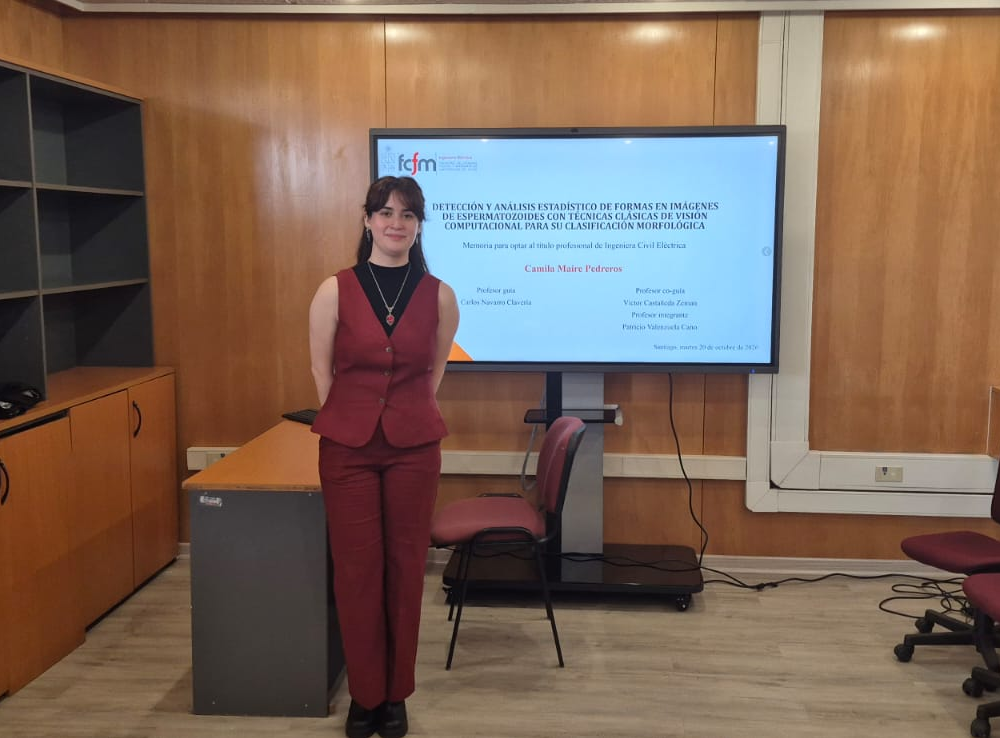
The research developed a hybrid pipeline combining deep learning-based segmentation with classical computer vision and neural network classification. A U-Net model identifies sperm heads in microscopy images, after which geometric descriptors characterize their shape. These features are then used by a lightweight multilayer perceptron to classify morphological subtypes. By integrating deep learning with interpretable geometric measurements, the proposed approach seeks to balance classification performance, computational efficiency, and transparency.
The hybrid model achieved 84.21% accuracy, outperforming the end-to-end convolutional neural network evaluated in the study, which achieved 76.92%. The hybrid classifier also used approximately fourteen times fewer parameters. These findings illustrate how combining established computer vision methods with deep learning can offer an effective alternative to relying exclusively on increasingly complex neural network architectures. Further improvements, particularly in the classification of challenging morphological subtypes, remain an important direction for future research.
At Tech4MEDICS, we believe that meaningful advances in medical technology emerge from collaboration across disciplines and from the careful integration of different methodological approaches. Camila’s research exemplifies this principle: rather than relying exclusively on complex models, it combines modern learning algorithms with classical image analysis to develop a more interpretable computational solution. This work contributes to our broader interest in applying engineering and artificial intelligence to challenges in healthcare.
Our research environment is also built around continuous collaboration and student development. The Tech4MEDICS team meets weekly to review research progress, discuss technical challenges, exchange ideas, and provide feedback to students as their projects evolve. These meetings are an essential part of our collective effort to foster rigorous research and interdisciplinary training at the intersection of engineering and medicine.
We congratulate Camila Maire Pedreros on completing this important academic milestone and acknowledge the contributions of Professor Carlos Navarro Clavería, thesis supervisor, Professor Víctor Castañeda Zeman, co-supervisor, and Professor Patricio Valenzuela Cano, member of the evaluation committee. We look forward to seeing how Camila’s work and future research contribute to the continued development of computational methods for healthcare applications.